Service
Wolf convection steam oven repair — water faults and descale messages
A steam oven is a water system with an oven built around it, and its faults run in a fixed order — passages first, sensing second, the generator last. Caught early it is a clean; caught late it is a part.
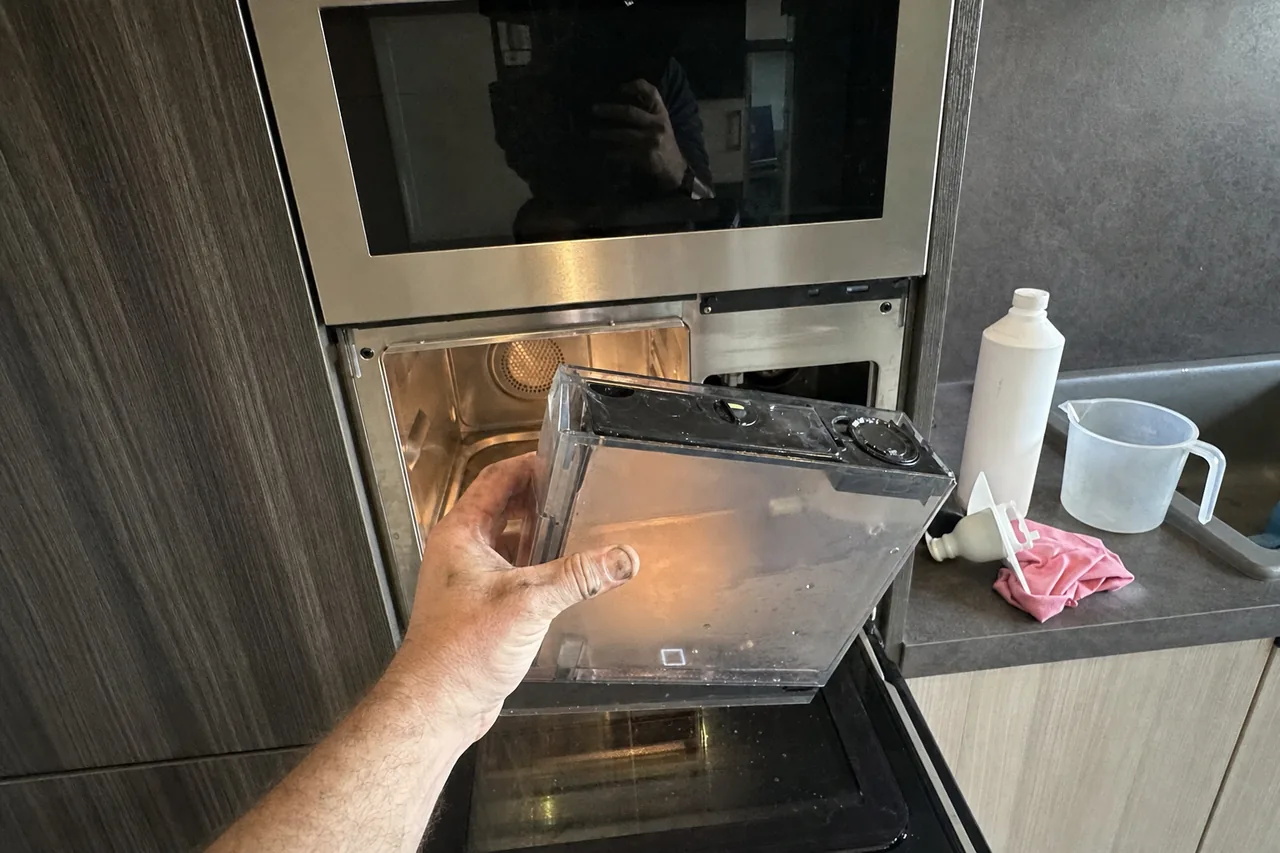
What people describe when they call
- The oven asks to be descaled and will not clear the message
- Steam output has fallen off and food comes out dry
- The reservoir empties far faster than it used to
- Water is left standing in the cavity after a cycle
- The cavity smells of hot mineral rather than food
- A cycle aborts partway through and reports a water fault
- The door glass fogs and stays fogged
- The reservoir reads empty when it is visibly full
- White crust has appeared around the steam inlet
A convection steam oven is a water system with an oven built around it. Everything that goes wrong with it that is not simply an oven fault happens somewhere on the path between the reservoir and the cavity, and that path fails in a consistent order. Knowing the order is most of the diagnosis.
The order in which things fail
The first thing to go is not the generator. It is the pickup and the passages. A route sized for clean water narrows, flow drops, and the oven starts reporting that it cannot get water while the reservoir is plainly full. That is why a “water fault” on a well-used steam oven is more often a restriction than a pump.
Next is the level sensing. Whether the appliance uses a float or a conductivity probe, deposit on the sensing element changes what it reports, and a sensor that lies about the level produces cycles that abort at unpredictable points. This is the stage at which people start describing the oven as having a mind of its own.
The generator and its heating element come last, and by then it is a larger repair. That ordering is the whole argument for acting at the first stage rather than the third — the first is a cleaning job, the third is a part.
Standing water and fogged glass
Water left in the cavity after a cycle looks like a pump failure and usually is not. A blocked drain and a failed pump present identically from the front of the appliance, and only one of them is a part worth ordering, so the drain path gets proved before the pump is condemned.
Persistently fogged door glass points at the gasket or the inner glass seal rather than at the steam system at all — the cavity is losing steam into the door pack. That is a door job, and it is worth catching, because steam finding its way into a door pack does not stop at the glass.
Descaling, and what the prompt actually is
The descale prompt is a counter, not a measurement. The appliance has no way of knowing what is going through it; it knows how many cycles it has run. Treat the interval as an upper bound, and act on the prompt the first time it appears rather than the third.
If a descale cycle no longer clears the prompt, stop repeating it. A cycle that will not complete is reporting a restriction somewhere in the path, and running a chemical cycle a fourth time does not clear a restriction — it puts more descaler through a passage the descaler is not reaching the far side of. That is the point at which it becomes a service call rather than a chore, and it is a much smaller repair then than three months later.
What a steam oven visit actually involves
These are built-in appliances, and the fault is very often behind the unit rather than in front of it. Expect the oven to come out of its cabinet: the water connections, the drain, the generator and the harness are all reached from the back and the underside. That means a clear run in front of the opening, somewhere to stand the appliance, and a few minutes at each end that a countertop machine would not need.
Two things we establish before touching anything. Whether the oven is fed from a reservoir or plumbed into a supply line, because the fault list is different and a plumbed unit brings its own inlet valve, filter and shut-off into scope. And whether it is on a circuit of its own, because an appliance sharing a circuit with something that cycles will behave intermittently under load and look electronic when it is not.
Parts, lead times and the serial number
Have the rating plate ready when you call — model and serial. Assemblies change mid-production, and a steam oven’s generator, pump, inlet valve and board can all be serial-dependent even where the model badge is identical. Ordering from the model alone is how a two-visit repair becomes three.
Common items we can usually move on quickly. Serial-specific assemblies go on order, and lead time is part of the written estimate rather than a surprise a week later. If the honest answer is that a part is discontinued with no equivalent, we say so on the visit and charge the diagnostic rather than sell a repair we do not believe in.
On the visit
We work the water path in order, reservoir to cavity, because the failures are sequential and the cheap one comes first. Flat $80 to diagnose, credited in full toward the repair. Written estimate before any part is ordered. Ninety days on labour, 365 on parts, genuine OEM only.
What gets checked
- Reservoir seal and the pickup tube, which is the first passage to narrow
- Generator condition, measured rather than assumed
- Water level sensing and the float or probe circuit that reports it
- Drain path and pump, since standing water is often a blocked drain not a failed pump
- Descale cycle run end to end, watching where it stalls rather than only whether it clears
- Door gasket compression, because a cavity that will not hold steam will not cook
- Supply and circuit, and any power event the household remembers
Flat $80 diagnostic, credited to the repair. You get a written estimate before any part is ordered or any labour is billed. 90 days on labour, 365 days on parts, genuine OEM parts only.
The fee, then the band the part sits in
Money
What does convection steam oven repair cost?
The bands below are the ones this work falls into. Everything else on the book is on the pricing page.
| Work | Parts and labour |
|---|---|
| Diagnostic visit | $80 flat, credited |
| Door hinge, glass or seal | $180–$640 |
| Convection fan or motor | $250–$730 |
| Oven thermostat or temperature sensor | $170–$520 |
Bands, not quotes: they are what this work has actually cost, parts and labour together, from $80 at the door to the firm figure that goes on paper after the diagnosis. The whole table
- What does convection steam oven repair cost?
- The visit is a flat $80, credited in full against the repair. After that the price follows the component that failed: Door hinge, glass or seal runs $180–$640, convection fan or motor $250–$730, parts and labour together. You get a written estimate before any part is ordered or any labour is billed.
- Is the $80 charged on top of the repair bill?
- No. Flat $80 diagnostic covering the visit and the full diagnostic sequence, credited toward the repair once you approve the work. If you decide against the work, the fee stands and the written diagnosis is yours to take anywhere — it names the failed part and the part number.
- When is replacing the appliance the better buy?
- Replacing instead of repairing runs $5,200–$10,500 (wall oven or built-in oven, the usual repair-or-replace comparison) or $8,500–$16,500 (dual-fuel or gas range, 36 inch and up). A comparable Wolf range, rangetop or wall oven, appliance only — before delivery, installation, ventilation or cabinetry. National appliance pricing, not Florida labour. Against those figures a repair at $180–$640 is the cheaper course in most kitchens.
Places this comes up
Written up in full
- A Wolf oven that won't turn on: the breaker, lockouts, outages and a dead display How to wake a silent Wolf oven: cycle the breaker for 30 seconds, rule out demo mode, the 12-hour shut-off and outage lockouts, then know when a dark display means a failed control part.
- What to check before you call us Some of these end the problem without a visit. The rest turn a vague complaint into a specific one, which is the difference between a diagnosis and a guess. Plus the three things not to touch.
What people said after this work
Customer feedback
After Convection steam oven calls
4.3 out of 5, across 87 customer reviews. Each entry below is one visit, in the words of the person who paid for it.
Descaling had been skipped for years before we bought the house. He worked the boiler through properly rather than clearing the prompt, and said what would happen if it is left again. Booked twice to get him.
Cosima P.
The door seal had hardened and the oven was venting into the cabinet above it. He fitted a new seal, checked the hinge tension, and showed us the swollen shelf edge so we could see what it had been doing.
Casimir N.
Our steam oven took far longer to reach temperature than it used to. He found the generator scaled and a seal weeping onto the shield below it, cleaned one and renewed the other. Slow to get a slot.
Wendelin A.