maintenance
What to check before you call us
Some of these end the problem without a visit. The rest turn a vague complaint into a specific one, which is the difference between a diagnosis and a guess. Plus the three things not to touch.
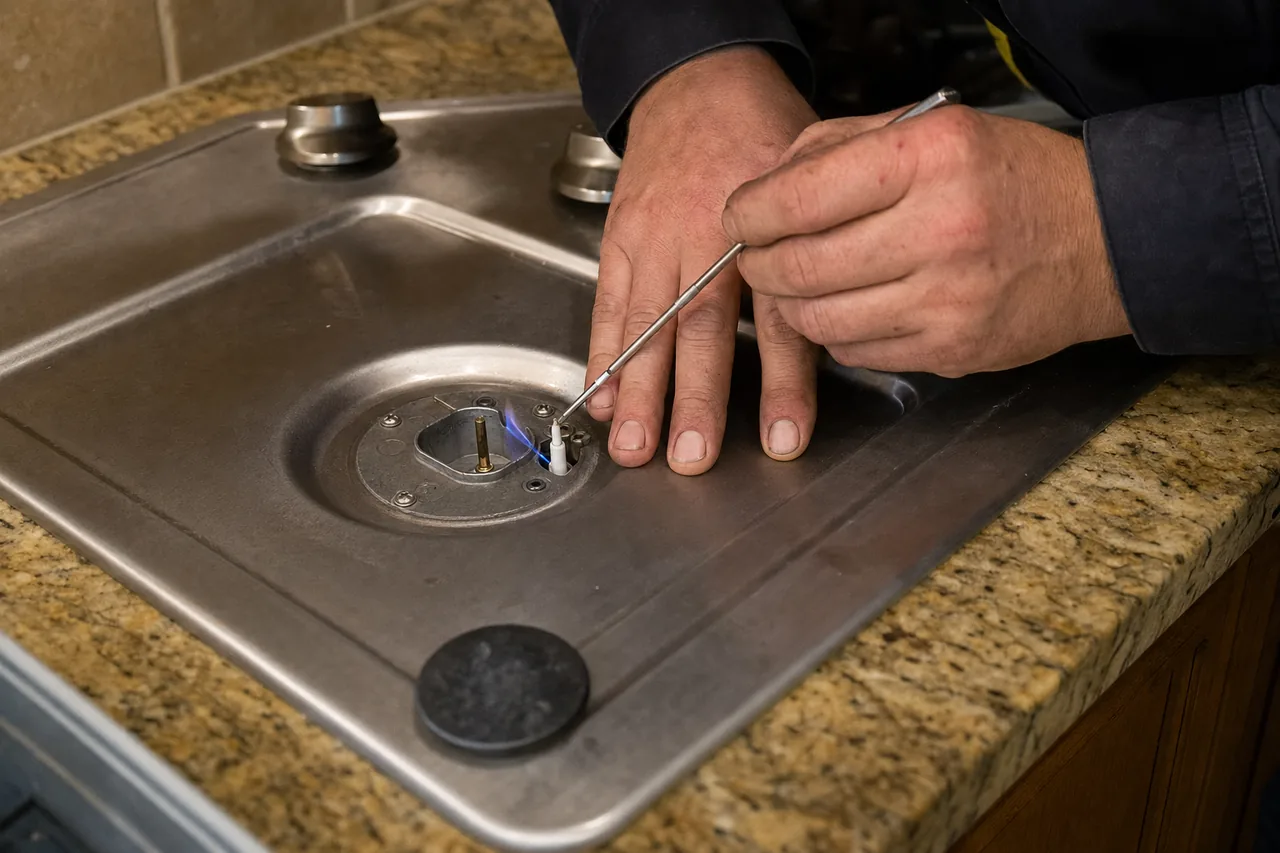
We would rather you did not need us. Failing that, we would rather arrive at a specific problem than a vague one, because a diagnostic visit spent measuring is worth far more than one spent narrowing down.
Here is what is genuinely worth doing first. All of it is safe, none of it needs tools you do not own, and it takes about ten minutes.
Establish what still works
The most useful information you can gather is the boundary of the fault.
If a burner will not light, try every other burner. If the oven will not heat, try broil as well as bake. If one zone of an induction cooktop drops out, try the same pan on a different zone and a different pan on the same zone. If a double oven misbehaves, check whether both cavities do.
Every one of these answers eliminates half the possible causes. “The left front burner will not light and the other four do” is a diagnosis most of the way finished. “The cooktop is not working” is a starting point.
Look at the flame
On a gas appliance the flame is the best instrument in the room, and it is free to read.
A good flame is blue, steady, and sits down on the burner cap. A flame that is yellow-tipped and lifts away from the cap is running the wrong air-to-gas ratio, and that is a supply, regulator or conversion issue affecting the whole appliance rather than one burner. A flame that is fine on high but dies on low points at the low-flame adjustment or a valve.
Note which burners do what. Write it down before you call — it is surprisingly hard to recall accurately with a technician standing in the kitchen.
Reseat what lifts off
Burner caps come off for cleaning and go back on at a slight angle more often than anyone would guess, and a cap a millimetre out of its seat puts the spark somewhere the gas is not. Lift each one and set it back deliberately.
Baffle filters in a hood are the same story. A filter that is not properly in its track leaves an open path that short-circuits the capture area, so the hood pulls air through the gap instead of over the pan. While they are out, wash them — a loaded filter passes grease onto the blower wheel, which is how a cheap problem becomes an expensive one.
Check the things nobody checks
The cabinet vent. A built-in oven or an induction cooktop sheds heat into the cabinetry and relies on a clear path out. A drawer packed to the top under a cooktop, or a shelf added inside a cabinet during a remodel, produces overheating that reads as an electronic fault. An induction zone that works for a few minutes at high power, shuts down, cools and comes back is describing exactly this.
The exterior damper. Go outside and look at the vent your hood exhausts through. On the coast these corrode open or shut, and they are the cheapest part in the whole system.
The door seal. Run the oven to temperature and move the back of your hand slowly along the door edge, an inch or two away. If you feel heat escaping at one top corner, the door is not sealing flat, and that alone will stop an oven holding a setpoint.
Whether anything changed. New water softener, new panel work, a new gas supply, a renovation that sealed the house up, a range that was moved. Appliance faults that appear within a few months of building work are frequently building work. Tell us about it — it changes where we start.
Three things to leave alone
Anything behind a microwave or speed oven panel. The high-voltage section holds a charge after the appliance is unplugged. This is the one part of a kitchen where a home repair can be genuinely dangerous.
Burner ports, with anything metal. A wooden toothpick or a straightened paperclip to clear a blocked port is fine. A drill bit or a needle file is not: the port size is a calibration, and enlarging it is permanent.
A gas smell that persists with everything off. Not a diagnostic exercise. Shut off the appliance valve, ventilate the room, and get someone out.
When you do call
Have the model and serial to hand — they are on a plate, usually behind a door, under a drawer or along the frame edge. Tell us what still works as well as what does not, what changed recently, and how long it has been happening.
Our visit is a flat $80, credited in full toward the repair if you go ahead, and you get a written estimate before any part is ordered.